MNRE Makes ALMM List-II Mandatory from June 2026 – Impact on Solar Projects in India
India’s solar market is entering a new compliance era. The Ministry of New and Renewable Energy (MNRE) has amended the ALMM (Approved List of Models and Manufacturers) Order, 2019, introducing the long-awaited ALMM List-II for solar PV cells. The key change is simple but powerful: from 1 June 2026, solar PV modules used in covered projects must source their solar cells from ALMM List-II—not just the module brand being ALMM-listed, but the cells inside the modules too. :contentReference[oaicite:0]{index=0}
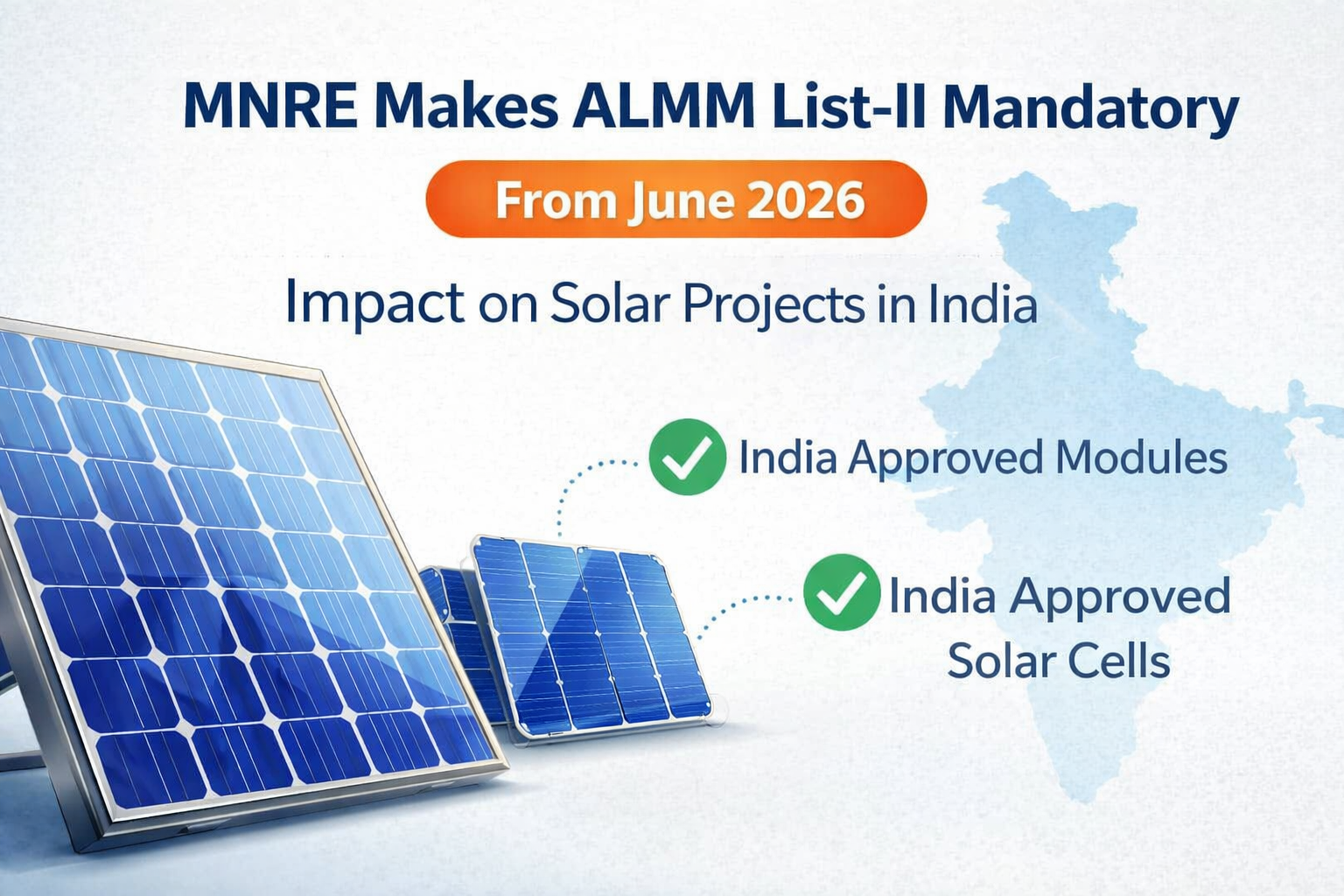
Table of Contents
1) Quick Summary (2-minute read) 2) What is ALMM, and why List-II matters? 3) What changes from 1 June 2026? 4) Which solar projects are covered? 5) Exemptions for existing bids 6) Impact on EPCs, developers, and customers 7) Will costs increase? Pricing reality & how to plan 8) Procurement strategy: how to avoid compliance risk 9) Special note: thin-film modules & integrated manufacturing 10) Documentation you should maintain (audit-ready) 11) Step-by-step compliance checklist 12) FAQs 13) Conclusion + next steps1) Quick Summary (2-minute read)
What’s the new rule?
Starting 1 June 2026, solar PV modules used in specified projects must source their solar PV cells from ALMM List-II. Until now, the ALMM framework largely focused on modules; this amendment brings solar cells under an approved listing framework as well. (As per official MNRE PIB notification)
Why does it matter?
This impacts procurement, pricing, and timelines. EPCs and developers must plan sourcing in advance, update vendor contracts, and keep documentation that proves ALMM compliance for both modules and cells.
Risk if you ignore this
If a covered project uses modules that do not source cells from ALMM List-II after the effective date, it may face compliance issues in approvals, inspections, subsidy/benefit eligibility, or contractual disputes (depending on project type and tender conditions).
Exemptions exist
Projects already bid out where the last date of bid submission is before issuance of the order can be exempt from the List-II cell requirement even if commissioned after 1 June 2026. :contentReference[oaicite:2]{index=2}
2) What is ALMM, and why List-II matters?
ALMM stands for Approved List of Models and Manufacturers of Solar Photovoltaic Modules. In practical terms, it is a government-approved listing system that helps ensure solar equipment meets defined standards of quality and reliability.
Historically, many project categories in India required the use of ALMM-listed modules. However, the supply chain has a deeper layer: solar cells are the heart of any module, and cell sourcing influences performance, degradation, reliability, and long-term output.
MNRE’s amendment introduces ALMM List-II for solar PV cells and states that from 1 June 2026, solar PV modules used in covered projects must source their solar cells from List-II. :contentReference[oaicite:3]{index=3}
Why the government is doing this
- Domestic manufacturing boost: Encourages investment in Indian solar cell production capacity and higher-value manufacturing.
- Quality assurance: A listing process creates a consistent benchmark for quality and reliability in solar PV cells used in India’s energy infrastructure. :contentReference[oaicite:4]{index=4}
- Energy security: Strengthens supply chain independence, reduces import dependency, and improves resilience during global disruptions.
- Climate and 2030 targets: MNRE links this to India’s broader clean-energy goals (including non-fossil capacity targets by 2030). :contentReference[oaicite:5]{index=5}
3) What changes from 1 June 2026?
The amendment clearly mentions that all solar PV modules used in projects must source their solar PV cells from ALMM List-II starting from 1 June 2026. (As stated in the official MNRE PIB release)
Before June 2026
- Many projects focused on compliance at the module level.
- Cell sourcing was often a supplier-side detail and could include domestic or imported cells.
- Documentation requirements were less cell-centric for many EPC workflows.
After June 2026
- Covered projects must ensure the cells used inside the modules are from ALMM List-II.
- Procurement teams must validate both: module ALMM listing + cell ALMM listing.
- Contracts, BoQs, purchase orders, and compliance packs will need updates to reflect this dual requirement.
| Area | What changes after 1 June 2026 |
|---|---|
| Vendor Selection | Choose module suppliers who can prove cell sourcing from ALMM List-II. |
| Project Planning | Plan procurement earlier to avoid supply bottlenecks and tender non-compliance. |
| Documentation | Keep ALMM listing references, traceability documents, batch/serial mapping, and invoices aligned. |
| Risk Management | Reduce chance of post-supply rejection, payment disputes, or commissioning delays. |
4) Which solar projects are covered?
The press release mentions that from 1 June 2026, modules used in projects including government-backed schemes, net-metering projects, and open access renewable energy initiatives must source their solar cells from ALMM List-II.
What this means in real life
If your project is associated with a government scheme, subsidy eligibility, regulated program, or a tender that references ALMM compliance, you should assume this requirement will be relevant. Even in private C&I scenarios, many financing partners and large customers align procurement with government standards to reduce risk.
5) Exemptions for existing bids
MNRE has provided an important relief: for projects that have already been bid out where the last date of bid submission is before issuance of the order, an exemption applies—such projects can proceed without the requirement to use cells from List-II, even if their commissioning is after 1 June 2026.
How to use this exemption correctly
- Maintain tender documents showing the bid submission dates.
- Keep official communications and award letters.
- Capture a compliance note in your project file: “Eligible under exemption clause due to bid date.”
- Still verify module-level ALMM requirements as per tender conditions.
Refer to official PIB notification →
6) Impact on EPCs, developers, and customers
6.1 Impact on Solar EPC Companies
EPCs will feel the most immediate operational impact because EPC teams manage procurement, installation timelines, commissioning documentation, and warranty handovers. Here’s what changes:
- Vendor shortlisting becomes stricter: Not every module vendor will have transparent, verifiable cell sourcing aligned to List-II.
- Lead time planning: If demand spikes for List-II compliant cells/modules, procurement lead times can rise temporarily.
- Contract updates: Purchase orders should mention List-II compliance and include penalties for non-compliance.
- Quality assurance: Cell sourcing + module QC improves consistency, reducing failures and warranty claims.
6.2 Impact on Developers & IPPs
Utility-scale developers and IPPs typically plan procurement months ahead, but pricing is sensitive. Under the List-II mandate:
- Bid pricing strategy changes: Post-2026 tenders may price-in domestic cell supply constraints.
- Bankability and compliance: Compliance confidence can improve lender comfort and reduce risk premiums.
- Supplier diversification: Developers may prefer multiple approved suppliers to hedge supply risk.
6.3 Impact on C&I (Net-metering / Open Access)
The release specifically mentions net-metering and open access initiatives. For C&I buyers, the impact is practical:
- Documentation needs: More paperwork to prove compliance (but it also improves transparency).
- Potential short-term price movement: A short-term uplift is possible if supply is tight.
- Long-term reliability: Better sourcing standards can improve performance confidence.
6.4 Impact on Customers (Residential + MSME)
For end customers, the biggest benefits are long-term:
- Higher product reliability: Standardized listing and verification improves baseline quality.
- Better warranties and fewer disputes: Traceability helps resolve issues faster.
- Improved “Made in India” ecosystem: Stronger local manufacturing can stabilize supply over time.
7) Will costs increase? Pricing reality & how to plan
Whenever domestic sourcing rules tighten, the market’s first question is: “Will this make solar more expensive?” The honest answer is: short term volatility is possible, long term stability is likely.
Short term (next 6–18 months around the transition)
- Demand surge: Many EPCs and developers will rush to lock supply contracts.
- Capacity ramp-up: Domestic cell capacity is growing; during ramp-up, prices can fluctuate.
- Inventory decisions: Some companies may stock modules earlier to reduce risk.
Long term (post scale-up)
- Better domestic competition: More Indian cell production can improve price competitiveness.
- Lower import exposure: Reduced reliance on imports reduces forex and supply chain shocks.
- Higher trust and quality: Fewer failures and better energy yield can improve project economics.
8) Procurement strategy: how to avoid compliance risk
This policy is not only about buying modules—it’s about building an audit-ready procurement trail. Here is a practical procurement approach EPCs and developers can follow:
8.1 Create an “Approved Vendor List” (AVL) for 2026+
- List module brands you already use and verify their readiness for List-II cell sourcing.
- Ask for cell traceability documentation (batch IDs, manufacturing plant details, ALMM references).
- Prefer vendors with transparent supply chain mapping.
8.2 Update your purchase order templates
Add clauses like:
- Modules supplied must be ALMM compliant.
- Cells used must be sourced from ALMM List-II (for projects commissioned on/after 1 June 2026 where applicable).
- Vendor must provide compliance documents and indemnify the buyer against non-compliance.
8.3 Build a compliance pack for each project
Think of a compliance pack as a folder you can hand to any auditor, DISCOM, lender, or customer. It should include:
- ALMM listing references (module + cell, where required)
- Invoices and delivery challans
- Serial number / batch mapping to site installation
- Warranty documents and commissioning reports
9) Special note: thin-film modules & integrated manufacturing
The press release also recognizes thin-film solar technology. It states that thin-film solar modules manufactured in integrated solar PV module manufacturing units will be considered compliant with the requirement to use solar PV cells from List-II. :contentReference[oaicite:11]{index=11}
This is important for innovation and diversification. Thin-film technologies can have different supply chain structures compared to crystalline silicon modules. By acknowledging integrated thin-film manufacturing, MNRE is encouraging broader technology adoption while keeping the compliance goal intact.
10) Documentation you should maintain (audit-ready)
Strong documentation is the difference between smooth commissioning and painful disputes. Start building a standardized documentation checklist across all your projects.
Essential documents
- ALMM listing proof: Module listing reference + cell listing reference (List-II) where applicable.
- Supplier declarations: Letter confirming cell sourcing from List-II for relevant lots.
- Invoice + e-way bill + delivery challan: Must match quantities, model numbers, and site location.
- Serial/batch mapping sheet: Which module serial numbers were installed at which site/array.
- Warranty certificates: Including performance warranty terms.
- Commissioning report: Signed by project stakeholders (customer / EPC / inspector as needed).
Optional but highly recommended
- Incoming material inspection reports
- Flash test reports / EL images (if supplier provides)
- Photographic evidence of installation and nameplate/labels
11) Step-by-step compliance checklist (EPC/Developer)
Step 1: Identify whether your project is covered
- Government-backed scheme? Net-metering? Open access? Tender references ALMM? If yes, treat as covered.
Step 2: Confirm commissioning date
- If commissioning is on/after 1 June 2026, List-II cell sourcing becomes critical (unless exemption applies).
Step 3: Check exemption eligibility
- Was the project already bid out and the last date of bid submission before the issuance of the order? If yes, document exemption.
Step 4: Vendor due diligence
- Ask vendors: “Which ALMM List-II cell manufacturer/batch will be used?”
- Request documentation upfront.
Step 5: Update PO/contract clauses
- Add List-II compliance terms and penalties for non-compliance.
Step 6: Create a project compliance folder
- Maintain a single folder (digital) with all ALMM, invoices, serial mapping, warranties, and commissioning documents.
Step 7: Commissioning readiness
- Before requesting inspection/commissioning sign-off, verify all documents are complete and consistent.
12) FAQs
What exactly is MNRE’s new requirement from June 2026?
From 1 June 2026, solar PV modules used in covered projects must source their solar PV cells from ALMM List-II, in addition to module compliance under ALMM.
Which projects does the press release explicitly mention?
It explicitly mentions coverage including government-backed schemes, net-metering projects, and open access renewable energy initiatives.
Are already-awarded projects exempt?
Projects already bid out where the last date of bid submission is before issuance of the order can be exempt from the List-II cell requirement even if commissioning is after 1 June 2026.
Will this stop imported cells immediately?
For covered projects commissioned on/after 1 June 2026, the requirement is to source cells from ALMM List-II. In practice, that encourages domestic/approved supply chains for those categories, while exemptions and non-covered segments may have different realities.
Does MNRE mention thin-film modules?
Yes. Thin-film solar modules manufactured in integrated solar PV module manufacturing units will be considered compliant with the requirement to use solar PV cells from List-II.
13) Conclusion + next steps
MNRE’s amendment to the ALMM Order, 2019 is a decisive step toward strengthening India’s solar manufacturing ecosystem and improving quality assurance in the solar supply chain. The headline change is clear: from 1 June 2026, solar PV modules used in covered projects must source solar PV cells from ALMM List-II.
For EPCs and developers, this is not just a “policy update”—it’s a practical shift that will influence procurement planning, vendor selection, and project documentation. The organizations that prepare early will face fewer delays, fewer compliance disputes, and better project execution.